


What determines the hourly electricity price?
The hourly electricity price is determined by supply and demand on the energy market. If there is a lot of electricity available and demand remains low, the price will drop. If demand is high and supply is limited, the price will rise.
- Demand for electricity: Demand is highest in the morning and evening, which results in higher prices.
- Generation of sustainable energy: a lot of sun or wind ensures extra supply and therefore lower prices.
- Availability of power plants: when fewer power plants are available, the price may increase.
- Trading on energy markets (such as Day-Ahead and Intraday): this determines the value of electricity per hour.
- Weather conditions: temperature, sun and wind have a direct influence on both supply and demand.

What are peak and off-peak hours for electricity?
Peak and off-peak hours indicate when the demand for electricity is high or low. These moments have a direct influence on the electricity price.
- Peak hours are the times when a lot of electricity is used, usually between 7:00 AM–9:00 AM and 5:00 PM–9:00 PM. Demand is then high and electricity prices are often higher.
- Off-peak hours are the times when demand is low, usually between 11 p.m. and 6 a.m. and in many cases also around the middle of the day. Electricity is often cheaper, especially when a lot of sustainable energy is available.
With traditional energy contracts, peak and off-peak hours are often fixed. With dynamic contracts they can differ per day, because the electricity price is continuously determined by the current market situation.

What are the cheapest days for electricity?
The cheapest days for electricity usually fall on weekends, especially on Sundays. On that day, the demand for electricity is often lower, while the supply, for example due to solar energy, can be high.
This is often followed on Saturday and sometimes on Monday or Friday, depending on the week and market conditions. Within these days, the cheapest hours are usually between 9am and 5pm, with the lowest prices often around 12pm to 4pm.
Make a distinction between contract types. With traditional contracts, off-peak hours are usually fixed at night, while prices with dynamic contracts change hourly. The cheapest day is therefore not always the same, but weekend days and the middle of the day usually offer the greatest chance of low electricity prices.
What are the cheapest hours for electricity?
The cheapest hours for electricity are usually outside peak times, when demand is low and supply is high. In practice, this is often between 11:00 PM and 6:00 AM and between 11:00 AM and 3:00 PM.
At night, the demand for electricity is low, while power plants continue to produce. Around noon, solar panels provide a large supply, which pushes the price down. Prices can drop sharply during these hours, especially on sunny days.
With dynamic energy contracts, the exact cheap hours may vary per day. Yet they almost always fall outside the busy morning and evening hours, so these time blocks provide a good indication of when electricity is cheapest.
Why do electricity prices change more and more often per hour?
Growth of sustainable energy
Solar and wind energy do not consistently supply the same amount of electricity. During sunny or windy moments there is a lot of supply, while during cloudy or calm periods it disappears. These fluctuations ensure that prices can vary widely during the day.
Rapid changes in supply and demand
Electricity consumption changes continuously, for example due to peak times in the morning and evening. If demand suddenly increases and supply lags, prices will rise quickly. Conversely, prices fall when there is a temporary surplus.
Real-time energy markets
Electricity is traded on markets such as the Day-Ahead and Intraday markets, where prices are continuously adjusted to the current situation. As a result, the electricity price is increasingly determined per hour, and sometimes even shorter.
Rise of dynamic energy contracts
More and more companies and consumers are opting for contracts where the electricity price is directly linked to the market. This makes price differences per hour visible and creates more awareness and the opportunity to actively manage them.
Due to these developments, electricity prices are becoming increasingly dynamic and closely linked to what is happening in the energy grid at that moment.
Can companies respond intelligently to peak and off-peak hours?
Yes. Companies can actively respond to peak and off-peak hours by smartly managing their energy consumption and generation. By moving energy-intensive processes to times when electricity is cheaper, they immediately reduce their costs. In practice this means, for example:
- running machines or installations during off-peak hours;
- charge batteries at low prices and discharge during peak hours;
- deploy charging infrastructure at times with cheap electricity;
- tailor production processes to available sustainable energy.
This does require flexibility and timing. Because electricity prices change hourly, manual switching is often not sufficient to take full advantage.
That is why more and more companies are opting for automation, where systems respond to price changes in real time and automatically control energy assets. This makes responding to peak and off-peak hours not only possible, but also scalable and profitable.
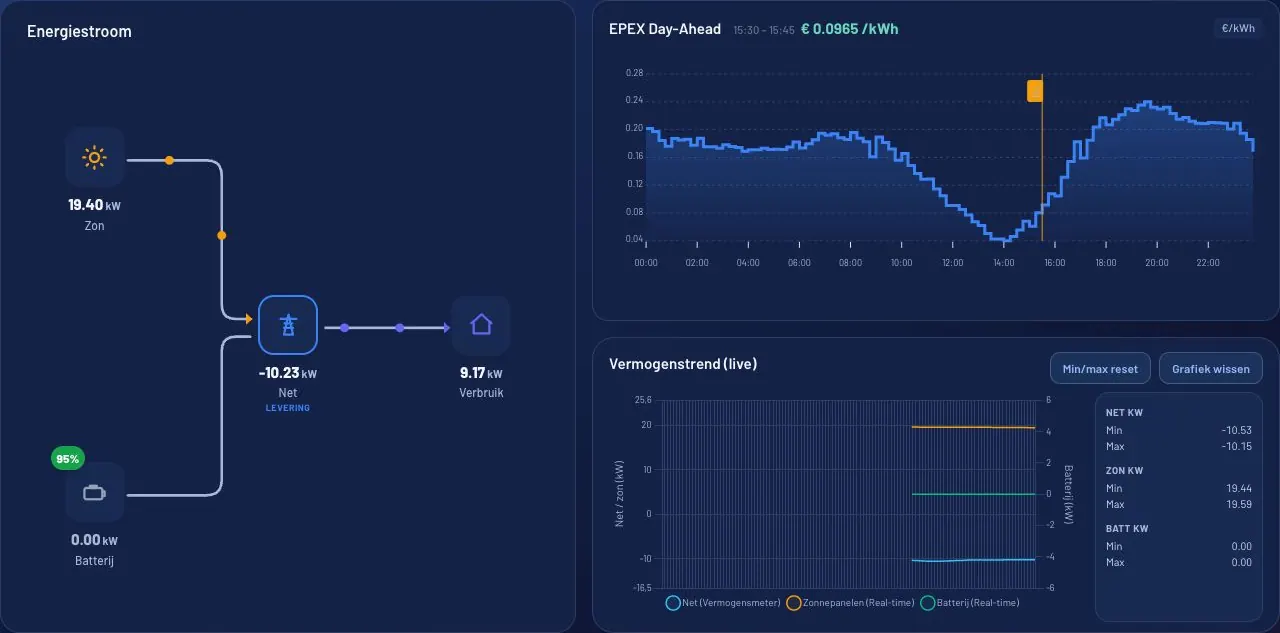
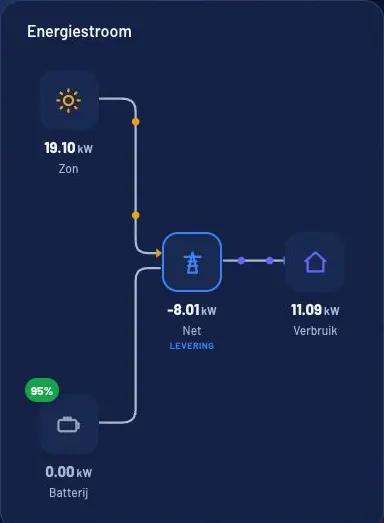
Smartbox
Smartbox: the solution for smart energy management
The Smartbox is an energy management system (EMS) that automatically controls energy assets such as batteries, solar panels and charging infrastructure based on real-time control signals from an aggregator.
The system ensures that installations respond immediately and correctly to signals from flexibility and balancing markets. What does the system do?
- Receives real-time control signals from the aggregator and translates them directly into concrete control of energy assets.
- Ensures that batteries, charging infrastructure and other installations respond within seconds to activations from balancing markets.
- Controls batteries to charge or discharge when flexibility is needed on the electricity grid.
- Dynamically regulates charging infrastructure so that it matches the requested grid load or market situation.
- Automatically adjusts sustainable generation when necessary to keep the electricity system in balance.
- Takes care of the technical implementation on location, so that assets do exactly what is controlled by the market.
Maximize the return on energy assets with Smartbox
As an energy company or installer], do you want to get more value from your customer portfolio? With Smartbox you make energy installations an active and profitable part of the energy market, without additional complexity for the end user.
Become a partner of Smartbox and discover how you can strengthen your proposition with smart energy management. Contact us by phone, email or our contact form.