


What is the EPEX price?
The EPEX price is the price of electricity determined per hour on the European energy exchange EPEX SPOT. This price is expressed in euros per megawatt hour (€/MWh) and forms the basis for the electricity price in the Netherlands and other European countries.
The price is determined by supply and demand. If there is a lot of electricity available, for example due to high production of solar and wind energy, the price will drop. When demand is high or supply is limited, such as on cold days or when power stations fail, the price actually rises.
The most commonly used EPEX price comes from the Day-Ahead market, where hourly electricity prices for the next day are determined every day around noon. This means it is known in advance what electricity costs at each hour of the next day.
How is the EPEX price per hour determined?
The hourly EPEX price is determined through a day-ahead auction, which balances supply and demand for each hour of the following day. Every day around 12:00 noon, prices are determined for all 24 hours of the following day.
Supply and demand are submitted
Energy producers indicate how much electricity they want to supply per hour and at what price. At the same time, suppliers, traders and large customers indicate how much electricity they need per hour.
Ranking by merit order
All bids are sorted from cheapest to most expensive. Sustainable sources such as sun and wind are at the front, more expensive power stations such as gas stations at the back.
The most expensive plant required determines the price
The price for each hour is determined by the last (most expensive) power plant needed to meet the total demand. This sets the uniform market price for all electricity traded in that hour.
Calculation of hourly prices
An algorithm (EUPHEMIA) calculates the price per hour at which supply and demand are exactly in balance. This results in one EPEX price per hour, expressed in €/MWh.
These hourly prices form the basis for dynamic energy contracts. Suppliers usually add a surcharge and energy tax.
Why does the EPEX hourly price differ?
The EPEX price varies hourly because supply and demand are determined separately for each hour. Every hour forms a new equilibrium, so to speak, allowing the price to fluctuate continuously. The following factors influence the EPEX price.
Weather and sustainable generation
At sunny or windy times there is a large supply of electricity, which often lowers the price during those hours. When there is little sun or wind, or on cold days, the supply is more limited and prices are higher.
Consumption behavior during the day
The demand for electricity is highest in the morning and evening, for example by cooking, heating and charging electric vehicles. Demand is lower at night and often in the middle of the day, which results in lower prices.
International trade and grid tax
Electricity is continuously imported and exported between countries. Changes in this, or restrictions on the network, can affect the balance per hour and therefore the price.
What does a negative EPEX price mean?
A negative EPEX price means that more electricity is produced at that time than there is demand. The price then drops below zero, for example to −€5, −€10 or even −€50 per MWh.
- There is a surplus of power
- This often happens at sunny or windy moments, when a lot of sustainable energy is generated while demand is low.
- Producers want to lose electricity
- Because electricity cannot easily be stored on a large scale, producers sometimes choose to pay to turn off their power, rather than shut down installations.
At these times, return delivery is unfavorable and can even cost money. It is often wise to temporarily switch off energy assets or store energy locally instead of supplying it back.
Can you automatically manage energy assets based on the EPEX price?
Yes, energy assets can be controlled automatically based on the EPEX price. This is relevant because the electricity price changes per hour and manual switching is often not feasible in practice.
With an energy management system (EMS), energy assets automatically respond to price changes on the energy market. Think of batteries that charge during cheap hours, charging infrastructure that shifts power to favorable times, or installations that are temporarily reduced during negative prices.
Smartbox
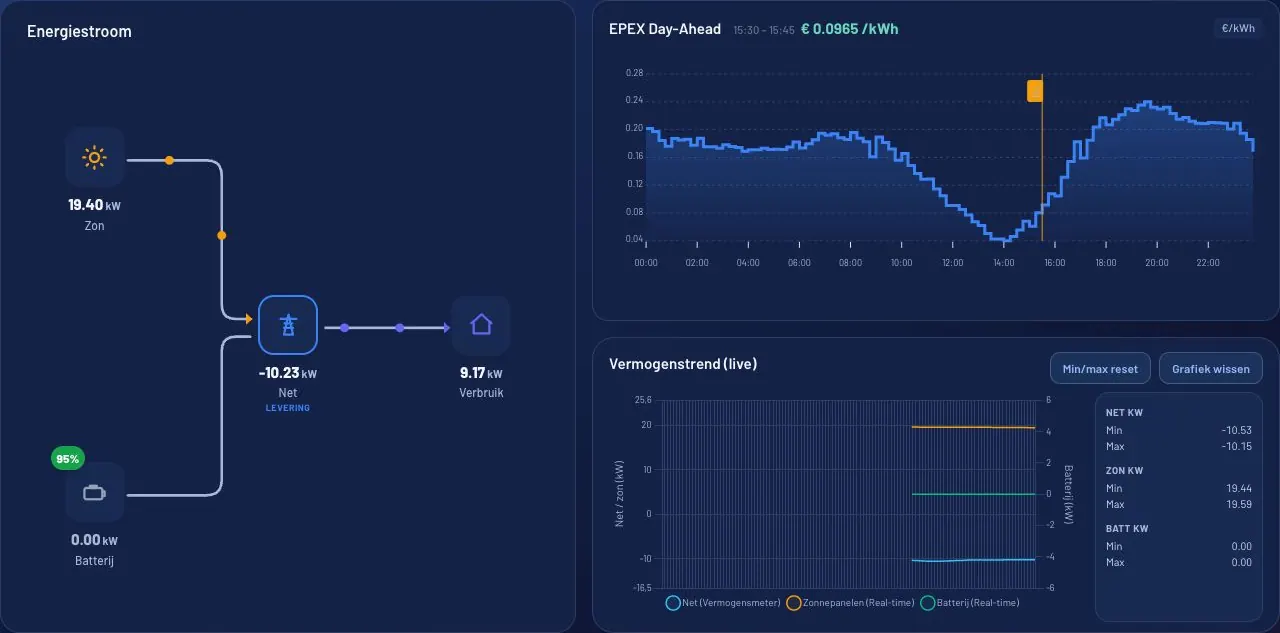
Smartbox: Real-time steering on the EPEX price
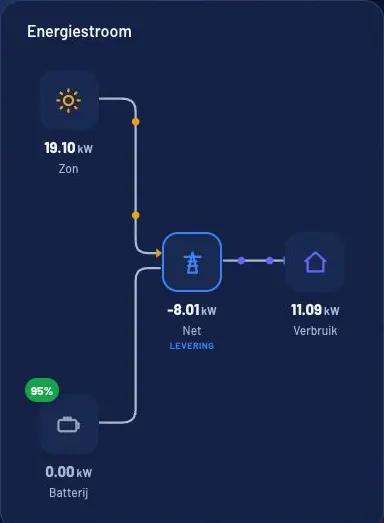
The Smartbox is an energy management system (EMS) that automatically controls energy assets such as batteries, solar panels and charging infrastructure] based on real-time control signals from the energy market. The system ensures that installations respond immediately and correctly to changes in the EPEX price.
What does the system do?
- Receives real-time control signals from the aggregator and translates them directly into concrete control of energy assets.
- Ensures that batteries, charging infrastructure and other installations automatically respond to price fluctuations and activations from the market.
- Controls energy assets to charge, discharge or temporarily switch off based on the current market situation.
- Prevents re-delivery in the event of negative EPEX prices by rescheduling installations in a timely manner.
- Ensures that energy assets continuously match the balance of the electricity grid and market demand.
Become a partner of Smartbox
As an energy company or installer, do you want to respond better to fluctuations in the EPEX price? With Smartbox you turn energy assets into a smartly controlled part of the energy market that automatically responds to real-time market signals.
Become a partner of Smartbox and discover how you can get more return from your customers' energy portfolio.